Dispatch No. 01 · Art & Animation
The Wonderful, Weird World of Walt & Dalí
A stained-glass wall, a 58-year-old cartoon, and the strange friendship between Walt Disney and Salvador Dalí.
 By Nicholas Kiley
11 min read
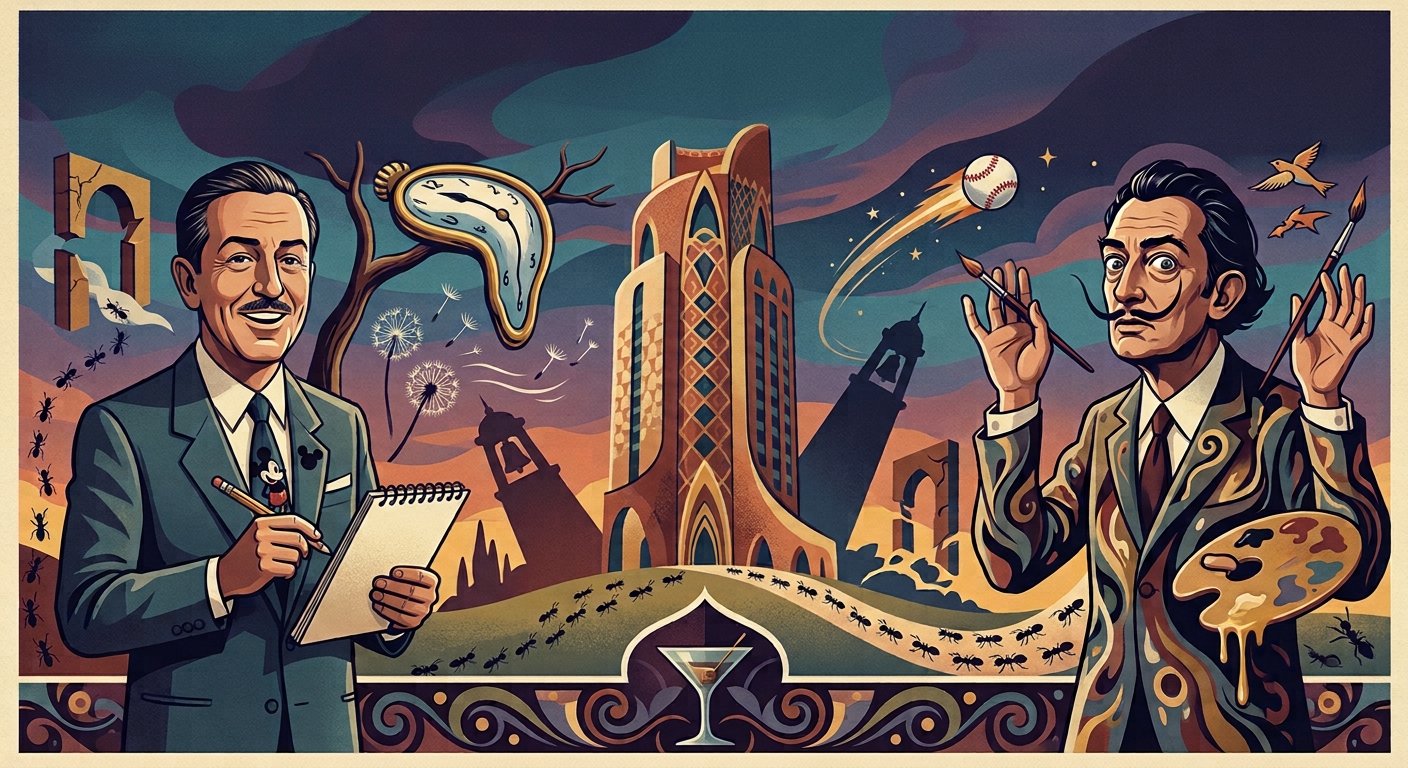
A Disney guy walks into a surrealist bar
I've worked at Walt Disney World on and off for more than 20 years, starting in 2004 as a College Program cast member in Magic Kingdom custodial.
So I've seen the magic from the guest side, the backstage side, and the side that involves a broom. Which makes it a little embarrassing how I found this story.
In July 2026, I spent my birthday at Disney's Coronado Springs Resort. At some point I wandered into the Barcelona Lounge in the lobby of the Gran Destino Tower, and what caught my attention was the big, colorful stained-glass artwork behind the bar. I liked it enough to start looking into the building. Which is how I learned the tower wasn't just vaguely Spanish. Its name came from a film. And the film came from Salvador Dalí.
That raised a reasonable question. Why is a Disney hotel tower in Central Florida named after a project involving a Spanish surrealist best known for melting clocks?
The answer is a short film called Destino. Walt Disney and Salvador Dalí started it together in 1945. It took 58 years to finish. And after two decades around this company, I'd somehow never really known the story.
The odd couple who maybe weren't
On paper, this pairing is ridiculous. Walt Disney was the man who made America's family entertainment. Dalí was the man with the upturned mustache, the ant-covered imagery and a gift for making reporters nervous.
The more I read, though, the less ridiculous it looked. They were born about three years apart, Walt in 1901 and Dalí in 1904, and both carried a small-town childhood into everything they made. Walt spent part of his boyhood in Marceline, Missouri, and spent the rest of his life rebuilding a version of Main Street. Dalí grew up in Figueres, in Catalonia, and spent the rest of his life painting that corner of Spain into dreams.
Here's how I've come to think about it. Walt built worlds that seemed impossible but somehow felt familiar. Dalí took familiar things, a clock, a telephone, an egg, and made them feel impossible. Same territory, opposite directions. Both were obsessed with dreams and perception and the idea that a picture could take you somewhere your rational brain never agreed to go. One of them just sold a lot more plush.
The interest ran both ways. Dalí had been eyeing Hollywood since the 1930s, and in a letter to the surrealist leader André Breton he bragged about making contact with what he called the three American surrealists: Harpo Marx, Cecil B. DeMille and Walt Disney. To Dalí, Disney was smuggling a child's unfiltered imagination into mass culture, which is more or less what the surrealists were trying to do with a lot more manifestos.
Walt, for his part, wasn't only the guy with the mouse. By the mid-1940s his studio had already put Fantasia's abstract shapes and Dumbo's "Pink Elephants on Parade" in front of family audiences. According to the Walt Disney Family Museum, Walt read Dalí's autobiography, The Secret Life of Salvador Dalí, then sent his copy to the artist asking for an autograph and suggesting they make something together. That is a very Walt move. Buy the book, get it signed, start a project.
I'm building my own small studio, one that's meant to cross writing, games, characters and other kinds of entertainment, so this is the part of the story that hooks me. Walt Disney the family entertainer is the version everyone knows. The guy who mailed a surrealist his own book to sign is more interesting.
Hollywood, 1945
Dalí didn't just wander onto the Disney lot. He'd come to Hollywood to design the dream sequence for Alfred Hitchcock's Spellbound, delivered far more than anyone asked for, and watched much of it get cut. The experience reportedly left him eager to prove surrealism could work inside the studio system.
In 1945, Walt brought him in to design a surreal animated short, planned as one segment of a "package" feature, the anthology films Disney was making in the 1940s. Starting in early 1946, Dalí split his time between Pebble Beach and the studio in Burbank. He was paired with story artist John Hench, whose job was essentially to translate Dalí into animation, and the two spent roughly eight months on storyboards, paintings and ideas.
The film was built around "Destino," a love song by Mexican composer Armando Domínguez. Disney had it recorded by Dora Luz, the same singer who serenaded Donald Duck in The Three Caballeros a year earlier. The voice that sang to Donald also sang for Dalí.
By most accounts Dalí was ferociously productive, filling storyboards where nearly everything was meant to move and morph into something else. Hench later recalled Walt being genuinely captivated and mostly letting him run.
Mostly. At some point the storyboards drifted into a baseball sequence, which is a sentence I never expected to type about Salvador Dalí. One studio veteran later remembered Walt losing his temper when baseball players started crowding out the film's heroine. It's a secondhand memory, so take it with a grain of salt, but the baseball itself is real: it survives in the finished film. A newspaper writer of the era had already summed up the project as sounding "like Sigmund Freud on a lost weekend."
Then it stalled, and the accounts don't fully agree on why. NPR reported that Disney and its distribution partner RKO decided the short probably wouldn't make money. The Walt Disney Family Museum says Walt's and Dalí's approaches to storytelling kept drifting apart, and that work had stopped by 1948. Either way, postwar Disney was not flush with cash, and a surrealist art short was not going to fix that.
Before it went into storage, Hench pieced together about 17 seconds of test animation built around a pair of tortoises, hoping to keep the idea alive. It went into the archive anyway.
As someone who has worked inside the company, I find this part weirdly comforting. Even Walt Disney, with Salvador Dalí sitting in his building, had projects die because the budget said no.
Even Walt Disney, with Salvador Dalí sitting in his building, had projects die because the budget said no.
Friends anyway
The film died. The friendship didn't.
In 1951, Dalí visited Walt at home and took a ride on the Carolwood Pacific, the one-eighth-scale steam train Walt ran around his backyard. Salvador Dalí, mustache and all, chugging around a Los Angeles backyard on a miniature locomotive is an image I'm a little surprised Disney hasn't put on a T-shirt.
In 1957, Walt and his wife Lillian visited the Dalís at their home in Portlligat, on the Spanish coast. According to the museum, they talked about two more projects, Don Quixote and El Cid. Walt had wanted to do an animated Don Quixote since the late 1930s, and the two of them apparently shared that dream. Neither film ever happened.
There are smaller traces too. Walt decorated his Palm Springs home with Dalí paintings. He kept a 1946 edition of Macbeth illustrated by Dalí, which the artist signed with a little Don Quixote drawing and a dedication in French to his very dear friend, Walt Disney.
NPR, reporting on the film's revival in 2003, said Walt later regretted shelving Destino. I'm not going to pretend to know what Walt felt. But you don't usually invite a guy to ride your backyard train, then travel to Spain to see him, unless you liked having him around.
So what is Destino, exactly?
It's short, somewhere between six and seven minutes depending on who's holding the stopwatch, which feels appropriate for a film about time. There's no dialogue. There's barely a plot in the usual sense. There's just that 1945 love song and a story that keeps rearranging itself while you watch.
The basic idea is a doomed romance between Chronos, the god of time, here a stone statue stuck in a desert, and Dahlia, a mortal woman who can't quite reach him. She dances toward him and he melts away. A clock oozes. Ants crawl out of a hole in a hand and turn into mustached men riding bicycles with loaves of bread on their heads. Telephones float. Dahlia steps into the shadow of a bell tower and wears it like a dress, then tips her head back and becomes a dandelion, scattering seeds. And yes, Chronos eventually ends up in a baseball uniform, hitting a ball that used to be a dancer.
Written down, it sounds like nonsense. The trick is that nothing just sits there. Everything turns into something else, and those transformations do the emotional work that dialogue normally would. The imagery is pure Dalí. The fluid, graceful movement holding it together is pure Disney.
What makes it such an odd piece of Disney history is that it doesn't belong to anything. It isn't a franchise. It isn't a ride. It's not quite Fantasia, though it clearly comes from the same restless 1940s period, when Walt was setting music to images and trying things that didn't fit a formula. It's a seven-ish-minute art film that a family entertainment company sat on for half a century.
Fifty-three years in a drawer
For decades, Destino existed only as storyboards, paintings and a few seconds of tortoise.
In 1999, Walt's nephew Roy E. Disney came across the project while working on Fantasia 2000 and decided to finish it. According to Animation Magazine, Roy had animators working on it for more than a year before telling then-CEO Michael Eisner, who was not thrilled to find out. If you've ever worked for a large corporation, that's either inspiring or terrifying.
There was also a business case, which is so perfectly Disney. The same report says that completing the film gave the studio legal ownership of Dalí's original artwork for the project, which Roy estimated could be worth up to $10 million. The short reportedly cost about $1.5 million to finish. Rescuing a lost surrealist masterpiece was art. It was also a pretty good deal.
I don't say that cynically. That's the Disney I know. The art and the business are almost never separate, and sometimes the business is the reason the art gets finished.
The job went to Walt Disney Studios Paris, with director Dominique Monféry, in his first time directing, and producer Baker Bloodworth. A team of about 25 animators worked from Dalí and Hench's storyboards, notes from the journals of Dalí's wife Gala, and guidance from Hench himself, who was still around to help. They kept the original 1945 recording of the song and blended traditional hand-drawn animation, including Hench's old tortoise test, with some computer animation.
Destino premiered at the Annecy International Animated Film Festival on June 2, 2003, and was nominated for the Academy Award for Best Animated Short Film. Fifty-eight years from first sketches to premiere. I've waited in some long lines at Disney, but come on.
From St. Pete to Coronado Springs
The story doesn't stay in Hollywood, either. It runs straight through my part of Florida.
I live in the Tampa Bay area, a short drive from The Dalí Museum in St. Petersburg, home to one of the most significant collections of Dalí's work in the country. I've been. I enjoyed it, even though the tour guide was hard to hear, which at a surrealism museum almost felt like part of the exhibit. In 2016, that museum hosted an entire exhibition on this friendship, Disney and Dalí: Architects of the Imagination, organized with the Walt Disney Family Museum in San Francisco. Original paintings, story sketches, letters and photographs of the two of them, sitting right there on the St. Pete waterfront.
Then you head east on I-4, and a couple of hours later you're at Coronado Springs. Disney opened the 15-story Gran Destino Tower there in July 2019, named after the film. It's worth separating what in that building actually comes from Destino from what's just general Spanish flavor, because the resort mixes both.
The direct Destino references are more specific than I expected. The Dahlia Lounge, up at the top of the tower, is named for the film's heroine. Its dandelion-shaped chandeliers and metal bell accents come straight from the film's imagery, the bell tower whose shadow becomes Dahlia's dress and the dandelion her head turns into. When the tower opened, Disney historian Jim Korkis noted a large mural showing the heroine wearing the bell's shadow, screens playing the film itself in the lobby and the lounge, and a wall of photos of Walt and Dalí together.
The rest is broader Spain. The lobby is an homage to Catalan Modernism, with decorative panels based on Spanish tile designs from Barcelona and Toledo. The tower's restaurant, Tolédo, is a Spanish tapas and steak spot with no particular tie to the film. And the Barcelona Lounge, the lobby bar whose stained glass first pulled me in, is themed to the city of Barcelona, with warm colors and that stained-glass feature wall. Nothing I've found ties that glass to Dalí or Destino. So my whole discovery started at the one bar in the building that, as far as I can tell, has nothing to do with the story. The building is Spanish in general and Destino in particular, and the Destino parts are hiding in the light fixtures.
I like that a project abandoned in the 1940s left physical traces across Central Florida and Tampa Bay. One end is a museum full of Dalí's real work. The other is a hotel bar with chandeliers shaped like a dandelion from a cartoon he storyboarded in Burbank.
Last call
It's a strange trip for a few minutes of film. Started in Burbank, shelved after the war, finished in Paris by Walt's nephew, and eventually turned into a hotel tower in Central Florida, where a guy on a birthday trip went looking for the story behind some stained glass and found Salvador Dalí instead.
Walt Disney died in 1966. Salvador Dalí followed in 1989. Neither lived to see their little experiment become a finished film, much less inspire a 15-story hotel tower.
But I suspect Walt would have gotten a kick out of knowing that, decades later, his collaboration with one of history's greatest surrealists had inspired a hotel, a restaurant, and a place to sell $23 cocktails.
Dalí spent his career making the impossible seem real.
Walt Disney made the impossible possible.
And somehow, they both ended up on a cocktail menu.
Sources
- Walt Disney Treasures: Salvador Dalí — Walt Disney Family Museum
- Destino — D23
- Dalí's Disney Film — NPR, 2003
- Roy vs. Eisner: Secrets of Destino Revealed — Animation Magazine, 2004
- Salvador Dalí at Disney — Animation Obsessive
- Salvador Dalí and Three American Surrealists — MoMA
- Disney and Dalí: Architects of the Imagination — The Dalí Museum
- Spain and Dalí Inspire Gran Destino Tower — Travel Market Report, 2019
- A Friday Visit with Jim Korkis: Gran Destino Tower — yourfirstvisit.net, 2019
- Destino — Wikipedia
The Guest List
Get the next dispatch first.
New stories, episodes and first looks from inside the tower, straight to your inbox.
No spam. Unsubscribe anytime.