Dispatch No. 01 · Studio Notes
The Studio Is Open
An introduction to Nicholas Kiley Studios, the influences behind it, and the entertainment we’re setting out to create.
 By Nicholas Kiley
13 min read
The first thing I remember about Walt Disney World isn’t Cinderella Castle.
It’s steam rising off the water.
It was around 1995, and I was visiting Walt Disney World for the first time, staying at Disney’s Polynesian Resort. I grew up in Minneapolis, where winter is generally a long-running argument between human beings and the weather.
But that first morning in Florida, I looked out at the water and saw steam rising from it.
It was winter, and it was warm outside.
I thought that was incredible.
Apparently, there were places in America where you could go outside in the winter without dressing like you were preparing to cross Antarctica.
I’d found one.
More than thirty years later, I still remember that morning. Not because anything particularly spectacular happened, but because the entire experience felt so different from the world I’d come from.
That’s something great entertainment can do. It takes you somewhere else, even if only for a little while.
And I’ve been interested in that idea for most of my life.
A Lot More Than Mickey Mouse
Growing up in the late 1980s and 1990s was a pretty incredible time to fall in love with entertainment.
Disney was in the middle of its animation renaissance. Nintendo and Sega were battling for space in living rooms. Movie theaters were delivering the kinds of films that could dominate your imagination for years.
Jurassic Park. Back to the Future. Aladdin. The Lion King.
And that was before getting into basketball, professional wrestling, music, and whatever ridiculous movie I’d rented for the weekend.
Aladdin remains my favorite Disney movie, and Genie is my favorite Disney character.
Robin Williams could turn a scene into complete chaos and somehow make it better. As a kid, I just thought he was hilarious. Now I appreciate the writing, animation, performance, and sheer amount of imagination required to pull off a character like that.
I also remember seeing Beauty and the Beast at a late-night showing with my aunt and cousins.
It’s funny what sticks with you.
But my influences go well beyond Disney.
I loved the way Jurassic Park made dinosaurs feel like they actually existed. The combination of groundbreaking technology, suspense, music, and storytelling made the impossible seem real.
Back to the Future had a completely different kind of magic. A time-traveling DeLorean, a small town across multiple decades, characters you actually cared about, and a story that somehow made an incredibly complicated premise feel effortless.
Those movies didn’t just entertain me. They made me curious about how somebody came up with them in the first place.
Who designs a time machine out of a DeLorean?
Who figures out how to convince millions of people that a T. rex is standing in front of them?
And how do you take something that begins as an idea in somebody’s head and turn it into an experience the rest of the world can enjoy?
Those questions have always fascinated me.
The Imagineering Influence
If there’s one group of creative people I’ve particularly admired over the years, it’s Disney’s Imagineers.
Not simply because they build theme park rides.
Because of the way they think.
Imagineering brings together artists, engineers, writers, filmmakers, architects, designers, technicians, and people with skills that don’t always fit neatly into one category.
They’re asked to do something that sounds completely unreasonable.
Make a mountain that people can ride through.
Build a haunted mansion that’s funny and frightening at the same time.
Take an animated story and figure out how to make guests feel like they’re actually inside it.
And somehow, they do it.
I’ve always loved that approach to creativity.
The idea comes first. Then you figure out how to make it work.
Of course, there’s a lot more to it than that. Budgets exist. Physics exists. Fire codes exist.
Eventually, somebody has to explain why your incredibly ambitious concept can’t fit inside a building that already costs several hundred million dollars.
But that’s part of the challenge.
I’ve spent years reading about Imagineering, studying Disney history, and learning about the people who designed the attractions and experiences I’ve enjoyed since childhood.
People like Marty Sklar, Tony Baxter, Joe Rohde, and the original Imagineers who helped Walt Disney turn Disneyland into something the entertainment industry had never quite seen before.
What impresses me most isn’t just the finished attraction.
It’s the process of getting there.
The sketches. The models. The experiments. The ideas that changed dozens of times before anyone ever bought a ticket.
That’s the kind of creative environment I’ve always wanted to be part of.
And it’s a major influence on what I’d eventually like Nicholas Kiley Studios to become.
Not necessarily a company that builds roller coasters.
Although I’m certainly not ruling that out.
But a place where ideas can grow into things people actually experience.
A Few Other Influences
I’m also heavily influenced by sports.
Basketball in particular.
Kobe Bryant is my favorite basketball player of all time, and I’ve spent years appreciating not only his talent but the creativity involved in how he played the game.
The footwork. The improvisation. The ability to see an opportunity that everybody else seemed to miss.
Sports are entertainment, too.
The athletes, the rivalries, the presentation, the personalities, the traditions, the moments people remember for decades.
A great basketball game can tell a story just as effectively as a movie.
Sometimes better, because nobody knows the ending.
Growing up in Minneapolis also gave me a connection to a pretty remarkable music and entertainment culture.
Prince, First Avenue, the Minneapolis Sound, and the artists who helped give the city its creative identity.
Then there’s my Norwegian and Irish heritage, which influences a completely different side of my imagination.
I’ve always been fascinated by Norse mythology, Vikings, folklore, and the stories connected to the places my family came from.
I have family roots in Norway, including a family farm in Vats, and that history has become a source of ideas for some of the things I’m developing.
Irish folklore and history offer another entire collection of characters, legends, and possibilities.
And somewhere in the middle of all that are American pop culture, movies, music, sports, theme parks, and video games.
It’s a pretty strange collection of influences.
But I like it that way.
I don’t want to make just one kind of entertainment.
From Magic Kingdom to the Other Side of the Curtain
In 2004, at twenty years old, I moved to Florida to participate in the Walt Disney World College Program.
I worked custodial at Magic Kingdom.
Which is probably not the most glamorous way to enter the entertainment industry.
But it was an education.
There’s something interesting about growing up admiring a place, then suddenly finding yourself responsible for helping it operate.
One minute you’re appreciating the architecture, music, atmosphere, and attention to detail.
The next minute somebody’s handing you a broom.
Welcome to show business.
I learned a tremendous amount about Disney during those years.
I also learned that producing a magical experience requires an impressive amount of work that isn’t particularly magical.
I lived at Vista Way during the College Program, which could probably provide enough material for an entire separate publication.
Let’s just say the early-2000s Disney College Program was an experience.
I eventually returned to Disney full-time from 2007 to 2010 and worked in various roles at Magic Kingdom, including as a relief coordinator.
Today, I’m working for Disney again, although in a completely different part of the company.
I’ve also spent time working for Delta Air Lines, the Postal Service, and managing NASCAR promotional tours around the country for brands including Xfinity and Comcast.
Not exactly a traditional entertainment-industry résumé.
But those jobs exposed me to customer experiences, major brands, event production, operations, logistics, and the realities of making something happen in the real world.
And that’s something I’ve come to appreciate.
An idea can be brilliant.
But somebody still has to figure out how to build it, operate it, pay for it, and make sure the whole thing doesn’t fall apart the first time somebody touches it.
Disney taught me plenty about that.
So did NASCAR.
So did a few jobs I wouldn’t necessarily recommend to anybody.
The Studio I Want to Build
So where does all of this lead?
Nicholas Kiley Studios.
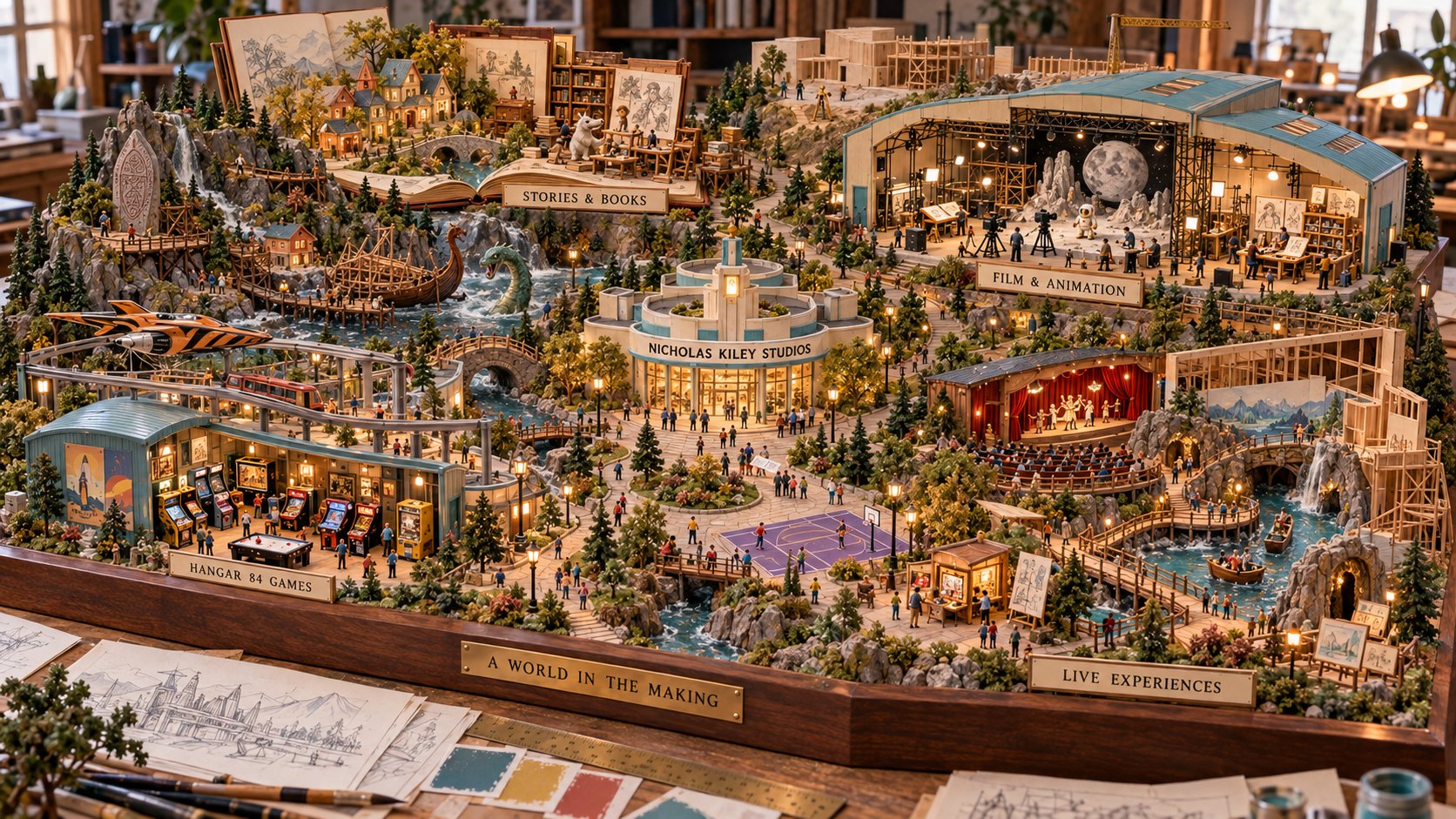
My goal is to build an independent entertainment company that creates original stories, characters, games, films, shows, books, and eventually experiences.
Not all at once.
I’m ambitious, not completely delusional.
But I want to build something that can grow across different kinds of entertainment.
I love the idea of creating a character in a video game who might eventually show up in a book, an animated short, a piece of merchandise, or something nobody has thought of yet.
I want to develop original worlds that people can return to.
Some might be funny. Some adventurous. Some strange. Others might be inspired by history, mythology, or the places I’ve known throughout my life.
And some ideas might be completely ridiculous.
That’s fine.
I don’t believe every successful entertainment property needs to begin with a profound message or a carefully constructed franchise strategy.
Sometimes somebody just comes up with something fun.
Then they make it.
And if people enjoy it, maybe there’s an opportunity to do more.
That’s the approach I want to take.
The studio will have different creative divisions, each with its own purpose.
Hangar 84 Games is where I’m developing original video games.
One of the first is Viking Kaos, a Norse-inspired action game that draws on mythology, classic arcade games, and my own Scandinavian roots.
I’m also exploring games inspired by Minneapolis, retro arcade sports, and the kinds of experiences I enjoyed growing up.
I want games that feel fun to play, not like they require you to earn a graduate degree in button combinations before you can get through the first level.
Kiley Kreative is the creative and design side, where branding, artwork, production, and other projects can come together.
And Nicholas Kiley Studios itself is the home for the larger entertainment projects.
Writing, audio, video, original properties, and eventually more ambitious productions.
I’d love to create animated series and films.
I’d love to publish books.
I’d love to develop merchandise based on characters and worlds I’ve created.
And yes, eventually, I’d love to create physical experiences.
Maybe something small. Maybe something much bigger.
I don’t know exactly what form that will take yet.
But I know I want to leave the possibility open.
Because that’s part of what I admire about Disney and Imagineering.
A good idea doesn’t necessarily have to stay in the medium where it started.
Entertainment Should Be Fun
One thing I feel strongly about is making genuinely entertaining things.
Especially entertainment families can enjoy together.
As a parent, I’ve developed an even greater appreciation for movies, games, and experiences that children and adults can enjoy without one group having to tolerate the entire thing for the sake of the other.
Some of my favorite movies growing up were just as entertaining for adults as they were for kids.
Aladdin is a perfect example.
Genie’s humor worked on multiple levels. Kids could enjoy the characters and the animation, while adults could appreciate jokes and references that went right over our heads.
That’s the kind of entertainment I’d love to contribute to.
But I also don’t want Nicholas Kiley Studios to be exclusively family entertainment.
I enjoy adult humor, satire, absurdity, and comedy that probably isn’t appropriate for an eight-year-old.
There should be room for both.
One project might be a family-friendly adventure.
Another might be a ridiculous comedy sketch.
Another might be a game inspired by mythology, a documentary-style story about entertainment history, or something I haven’t come up with yet.
The important part is that the audience knows what they’re getting.
And that whatever we make is actually entertaining.
I’ve been playing around with a simple guiding idea:
Laugh first. Anything useful is a side effect.
Not everything needs to teach a lesson.
Not every story needs to change your life.
Sometimes you just want to have a good time.
I think we could use a little more of that.
Why Now?
For years, I’ve had ideas that were difficult to pursue without significant resources.
Making a video game used to mean learning multiple specialized skills or hiring people who already had them.
Animation required a production pipeline.
Music required equipment, software, and often a fair amount of talent that I don’t personally possess.
And creating professional-looking video generally involved expensive cameras, editing tools, and people who knew what they were doing.
Those barriers haven’t disappeared.
But they’re changing.
Artificial intelligence and newer creative tools are making it possible for independent creators to experiment with ideas that would’ve been much harder to produce just a few years ago.
I’ve been exploring game development, writing, image generation, video, music, and narration.
And the possibilities are genuinely exciting.
Not because I think technology replaces creativity.
But because I can take an idea and begin making something out of it without waiting for permission or a large production budget.
Sometimes that means building a playable game prototype.
Sometimes it means producing a short video.
Sometimes it means making a piece of music and somehow finding myself distributing it to streaming services before I’ve fully considered whether that was a reasonable decision.
And sometimes it means trying to create a Jurassic Park-inspired scene with a giant sandwich, only for the software to insist the sandwich should move around like a living creature.
I didn’t ask for a living sandwich.
But apparently the technology had other ideas.
Those kinds of experiments are going to be part of the studio, too.
Some will work.
Some won’t.
And sometimes the failures will be funnier than the finished product.
I want to share that process, not just the polished results.
Building Something Worth Coming Back To
I don’t want Nicholas Kiley Studios to be a website where I occasionally post random projects and hope somebody notices.
I want it to become a place people return to because they’re interested in what we’re creating.
A place with recognizable characters, original entertainment, and a collection of projects that feel connected even when they’re completely different.
Maybe somebody discovers the studio through an article about Walt Disney.
Maybe they find a game through Hangar 84.
Maybe they watch a ridiculous video, listen to a podcast, or stumble across a character they end up loving.
And maybe, over time, those things begin to build an audience that wants to see what’s next.
I like the idea of people getting involved early.
Seeing projects evolve.
Following the development of a game from its first rough prototype to something actually worth playing.
Watching characters and stories take shape.
And occasionally seeing something go completely off the rails.
The website will be the main home for finished projects and studio updates. Patreon will offer a closer look at experiments, drafts, outtakes, and works in progress for anyone interested in the creative process.
But the main goal isn’t simply to produce more content.
It’s to build entertainment properties worth caring about.
Things that can grow.
Things that have a personality.
Things that people remember.
And hopefully, things that are fun.
Welcome to the Beginning
I still think about that first morning at the Polynesian.
A kid from Minneapolis, visiting Disney World for the first time, amazed that it was warm enough in the middle of winter to see steam rising off the water.
I didn’t know anything about Imagineering.
I didn’t understand the entertainment business.
I certainly wasn’t thinking about creating my own studio.
I just knew I was somewhere that felt completely different from home.
Years later, I went from visiting Magic Kingdom to working there.
And over time, my appreciation for Disney grew into a broader fascination with the entire entertainment industry.
The films. The games. The stories. The characters. The companies. The people who dream things up and figure out how to make them real.
That’s what inspires me.
Disney Imagineering. Steven Spielberg. The creativity of Back to the Future. The imagination behind Jurassic Park. The spectacle of professional sports. Minneapolis music. Norwegian mythology. Irish folklore. Classic video games.
All of it.
And now I want to see what I can make out of that collection of influences.
I’m starting small, but I’m thinking big.
I want Nicholas Kiley Studios to become a company that creates original entertainment across multiple mediums, develops memorable characters and worlds, and eventually produces experiences people can enjoy together.
I have no idea exactly how far that will go.
But I know I’m done leaving all these ideas sitting around waiting for some perfect opportunity.
I’d rather start building.
So welcome to Nicholas Kiley Studios.
There’s a lot I want to make.
And we’re just getting started.
Chaos included.
Keep reading
The Guest List
Get the next dispatch first.
New stories, episodes and first looks from inside the tower, straight to your inbox.
No spam. Unsubscribe anytime.